Luxury consumers are no longer searching the way they did even two years ago.
Instead of typing “best luxury watch London” into Google, they’re asking:
- What are the best independent luxury watch brands?
- Recommend a luxury interior designer specialising in contemporary penthouses.
- Who creates bespoke kitchens comparable to Smallbone?
- Which luxury travel company offers private expeditions to Antarctica?
The answer increasingly comes from AI assistants like ChatGPT, Google’s AI Overviews, Claude, Perplexity and Microsoft’s Copilot, not simply a list of blue links.
For luxury brands, this represents one of the biggest changes in digital marketing since the rise of Google Search.
Brands that understand AI Search Optimisation (AISO)-also referred to as Generative Engine Optimisation (GEO) will become the recommendations AI provides. Those relying solely on traditional SEO risk becoming increasingly invisible.
In this expert marketing and PR guide, the award-winning MirrorMePR team explain how AI search works, why it matters for luxury businesses, and the practical strategies we embrace that help premium brands earn recommendations from AI-powered search engines while strengthening traditional organic rankings.
What Is AI Search Optimisation?
AI Search Optimisation is the process of making your brand understandable, trustworthy and reference-worthy for artificial intelligence search systems.
Unlike traditional SEO, which focuses heavily on ranking webpages, AI systems attempt to answer questions directly by synthesising information from multiple trusted sources.
Rather than asking:
“Which website ranks first?”
AI asks:
“Which sources consistently demonstrate expertise, and can I confidently recommend them?”
This subtle difference changes everything.
Luxury brands must optimise not only for search engines, but also for language models that evaluate authority, expertise, reputation and consistency across the web.
Why Luxury Businesses Need AI Search Optimisation
Luxury consumer purchasing decisions rely heavily on trust.
Whether someone is investing in a £50,000 watch, commissioning an architect or booking a private yacht charter, they seek reassurance before making contact.
AI assistants are increasingly becoming that trusted advisor.
Instead of comparing dozens of websites, potential clients ask AI for recommendations, comparisons and expert opinions.
If your business isn’t recognised as an authority, you may never enter the consideration set.
For luxury companies, AI visibility often reaches audiences at the highest intent stage-when customers are ready to enquire rather than casually browse.
Traditional SEO vs AI Search Optimisation
Traditional SEO still matters. Google continues to drive enormous amounts of traffic.
However, AI search evaluates brands differently.
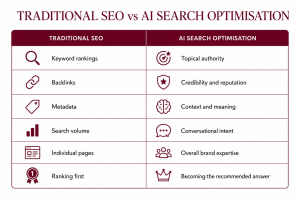
The strongest digital strategies now combine both approaches.
How AI Chooses Which Luxury Brands to Recommend
Although every AI platform operates differently, most evaluate several common trust signals.
1. Topical Industry Authority
Rather than publishing dozens of shallow blogs, luxury businesses should develop comprehensive expertise in their niche.
For example, a luxury interior design studio should create authoritative content covering areas such as:
- The inspiration behind the brand/collections/new products
- Quality products and materials
- Craftsmanship
- Bespoke approaches
- Project case studies
- Sustainability
- Client journeys
- Architectural collaboration
- Heritage
- Emerging design trends
Together, these create an interconnected knowledge ecosystem that AI understands.
2. Scaling Brand Reputation
In today’s AI world, AI increasingly considers how your luxury brand is discussed beyond your own website.
This covers a range of touch points for consumers, including:
- Media coverage
- High-profile industry awards
- Profile ‘meet the founder’ type interviews
- Professional associations
- High-quality publications
- Customer reviews
- Speaking engagements
- Podcasts
- Thought leadership
Luxury brands have always valued reputation. AI simply measures it digitally.
3. Entity Recognition
One of the most overlooked aspects of AI optimisation is becoming a recognised entity.
Rather than simply understanding pages, AI understands people, companies, products, locations and relationships.
Your luxury brand should consistently communicate the following throughout your marketing and PR:
- Company name
- Founder(s)
- Heritage
- Key People
- Location
- Services
- Areas served
- Awards
- Industry specialisms
- Years of experience
- Brand story
Consistency across every digital platform helps AI connect these signals.
4. Experience-Based Content
AI systems increasingly prioritise genuine expertise.
The strongest-performing content often includes:
- Original photography
- Real-life projects
- Behind-the-scenes insights
- Professional opinions
- Client outcomes & case studies
- Practical expertise
- Industry observations
Luxury businesses naturally possess these assets, but they often don’t publish them.
GEO: Generative Engine Optimisation Explained

Generative Engine Optimisation focuses specifically on improving visibility within AI-generated answers.
Rather than chasing keywords, GEO aims to create content AI models confidently cite or summarise.
Successful GEO content answers real questions clearly.
Examples include:
- How much does bespoke luxury interior design cost?
- What defines quiet luxury in architecture?
- How long does it take to commission a superyacht?
- What should buyers look for in handcrafted furniture?
These are precisely the types of questions prospective clients ask AI and your content should be looking to answer.
Content Strategies That Perform in AI Search
Luxury content should demonstrate expertise rather than simply promote products.
The most effective formats include:
Comprehensive Guides
Long-form educational resources establish authority while covering related concepts AI associates with your expertise.
Expert Commentary
Offer professional perspectives on industry developments rather than repeating existing news.
Comparison Articles
Articles comparing approaches, materials, or methodologies perform exceptionally well because users frequently ask AI comparative questions.
Case Studies
Highlighting detailed project breakdowns demonstrates genuine experience and expertise.
Frequently Asked Questions
Natural language questions closely mirror AI prompts.
Technical SEO Still Matters
It’s not just keywords or specialist content you need to focus on. AI search still depends on technically sound websites, designed to support this new method of search.
Essential foundations for any website includes:
- Alt tags
- Optimised metadescriptions
- Fast loading speeds
- Mobile responsiveness
- HTTPS security
- Structured data
- Clean site architecture
- Clear navigation
- XML sitemaps
- Descriptive headings
- Internal linking
- Safe and secure E-commerce
- Accessible content
Without these basics, even the most relevant and valuable content may struggle.
Build Topic Clusters Instead of Isolated Blogs
Many luxury businesses publish disconnected articles that don’t pull together brand expertise. If you’re looking to improve the value of your blog content, then build a pool of knowledge that shows AI your connected expertise.
For example, a luxury travel company might build a complete knowledge hub covering:
- Private safaris
- Expedition cruises
- Family travel
- Wellness retreats
- Sustainability
- Charter flights
- Concierge services
- Downloadable destination guides
- Seasonal recommendations
- Honeymoon highlights
Each article is designed to support the others, reinforcing authority.
Demonstrate Expertise, Experience, Authority and Trust

Google’s Experience, Expertise, Authoritativeness and Trustworthiness (E-E-A-T) principles remain highly relevant in today’s modern digital world.
Strengthen these trust signals further by incorporating the following:
- Publishing author biographies with genuine credentials
- Client reviews
- Testimonials from clients and partnerships
- Referencing industry research where appropriate
- Including original photography
- Revising articles regularly
- Featuring client testimonials
- Highlighting awards and accreditations
- Showcasing real projects and client experience
Luxury consumers expect authenticity, and AI increasingly rewards it.
Write for Conversations, Not Just Keywords
People interact with AI differently from search engines.
Instead of fragmented phrases, they ask complete questions.
Optimise for conversational searches such as:
- What is the difference between bespoke and made-to-measure luxury furniture?
- Which materials last longest in luxury kitchens?
- Is natural stone better than porcelain for premium interiors?
- How do I choose a luxury travel advisor?
PR PRO TIP: Make key and relevant questions in your content headings within your content.
Measure Success Beyond Rankings
AI optimisation introduces new performance indicators which brands should monitor. These include the following benchmarks:
- Growth in brand-name searches
- Organic enquiries
- Referral traffic to website
- Media mentions
- Citation frequency
- AI platform visibility
- Share of voice
- Engagement metrics across social media
- Conversion quality
Ultimately, qualified enquiries matter more than rankings alone.
Common Mistakes Luxury Brands Make
Many premium businesses unknowingly limit their AI visibility by consistently doing this:
- Publishing thin content focused only on products
- Ignoring educational resources
- Having inconsistent brand information
- Neglecting structured data
- Producing generic AI-written articles without expert input
- Failing to showcase genuine experience
- Optimising only for keywords instead of user intent
Luxury buyers seek expertise, and AI reflects that expectation of knowledge.
The Future of Luxury Digital Marketing
AI search is not replacing traditional SEO-it is reshaping how people discover trusted brands.
Luxury businesses that invest now in authoritative content, technical excellence and consistent brand signals will be better positioned as AI-powered search continues to evolve.
The brands most likely to thrive are those that educate rather than advertise, demonstrate expertise rather than make claims, and consistently provide value before the first enquiry.
For luxury businesses, visibility is no longer just about appearing on page one of Google. It is about becoming the brand that AI confidently recommends when discerning clients ask for the very best.
Frequently Asked Questions

What is AI Search Optimisation?
AI Search Optimisation (AISO) is the practice of improving your digital presence, so AI-powered search tools such as ChatGPT, Google AI and Perplexity recognise your brand as a credible source and recommend it in their responses.
Is AI Search Optimisation replacing SEO?
No. Traditional SEO remains essential, but AI Search Optimisation complements it by helping your content appear in AI-generated answers as well as organic search results.
What is Generative Engine Optimisation (GEO)?
Generative Engine Optimisation (GEO) focuses on creating authoritative, well-structured content that generative AI platforms can understand, trust and reference when answering user questions.
Why is AI search important for luxury brands?
Luxury purchases are typically research-intensive and trust-led. AI assistants increasingly influence buying decisions by recommending brands based on expertise, authority, reputation and content quality rather than keyword rankings alone.
How long does it take to see results?
As with traditional SEO, AI Search Optimisation is a long-term investment. Brands that consistently publish expert-led content, strengthen technical SEO and build digital authority are more likely to improve visibility over several months rather than weeks.
The Future Of AI Search?
The next era of search is less about chasing algorithms and more about earning trust, both from people and the AI systems they rely on. Luxury brands already have a competitive advantage through craftsmanship, expertise and heritage. The opportunity now is to communicate those strengths in a way that search engines and AI assistants can clearly understand, verify and recommend.
Businesses that act today won’t simply rank higher-they’ll become the trusted answers tomorrow’s clients receive first.