Quick Answer
 Quick Answer
There is no one-size-fits-all answer when choosing between a PR agency and an in-house PR team. A PR agency offers specialist expertise, established media relationships, flexibility, and access to a wider range of skills, while an in-house PR team delivers deeper brand immersion, immediate availability, and greater day-to-day control.
For many growing brands and businesses, a blended approach or partnering with a specialist PR agency delivers the best balance of strategic perspective, media access, and cost efficiency.
Understanding the Difference Between PR Agencies and In-House PR Teams
Public relations (PR) is essential for building brand reputation, increasing visibility, securing media coverage, managing crises, and creating meaningful bonds with consumers.
When deciding how to manage PR, businesses typically choose between two models:
- PR Agency: An external team of professional communications experts that develops and executes PR strategies for multiple clients across industries.
- In-House PR Team: PR professionals employed directly by a business who focus exclusively on managing that company’s communications and reputation.
Both options offer distinct advantages, and the right choice really hinges on your business goals, budget, growth stage, and communication needs.
The Advantages of Hiring a PR Agency

Access to a Team of PR Specialists
One of the biggest advantages of working with a PR agency is obtaining access to a diverse team of specialists.
A leading agency may offer expertise in:
- Media relations
- Brand strategy
- Press office management
- Influencer relations
- Product launches
- Event PR
- Crisis communications
- Thought leadership
- Digital PR
- SEO-driven content strategy
Rather than relying on one individual, businesses benefit from the combined experience of senior strategists, media specialists, copywriters, and communication professionals.
Established Media Relationships
PR agencies invest years into developing media relationships with journalists, editors, producers, and content creators.
These existing connections can help brands secure valuable opportunities in national, regional, industry, and digital publications.
While strong stories are always essential, a PR agency understands how to position a brand in a way that fits with what journalists and audiences are looking for.
A Fresh, Objective Perspective
Internal teams can become very close to their brand, which can sometimes make it difficult to identify new opportunities or question existing messaging.
An external PR agency brings an independent perspective, helping brands uncover unique story angles, identify emerging trends, and develop more effective campaigns.
Cost-Effective Access to Expertise
Building an internal PR department requires investment in salaries, training, software, media databases, and additional resources.
For many small and medium-sized businesses, a PR agency provides access to a full team of experts for a predictable monthly fee, frequently making it a more cost-effective solution.
Agile Flexibility
Every business evolves and changes throughout the year.
A PR agency can scale support around product launches, seasonal campaigns, events, international expansion, or crisis situations without the long-term commitment of hiring additional employees.
The Benefits of an In-House PR Team

In-depth Understanding of the Brand
In-house PR professionals work within the business every day, giving them a detailed understanding of company culture, products, values, and internal priorities.
This connection can support messaging and fast decision-making within some businesses.
Immediate Access and Communication
Having a PR professional in the office or integrated into the company’s internal communication channels allows for quick approvals, regular collaboration, and real-time updates.
An in-house PR can be particularly helpful for businesses with ongoing communication needs.
Greater Control Over Daily PR Activities
An in-house PR team has only one client, so it can dedicate its full attention to the company, managing ongoing communications, internal announcements, and day-to-day media enquiries.
For organisations with continuous PR demands, this dedicated focus may be advantageous.
PR Agency vs In-House PR: A Side-by-Side Comparison
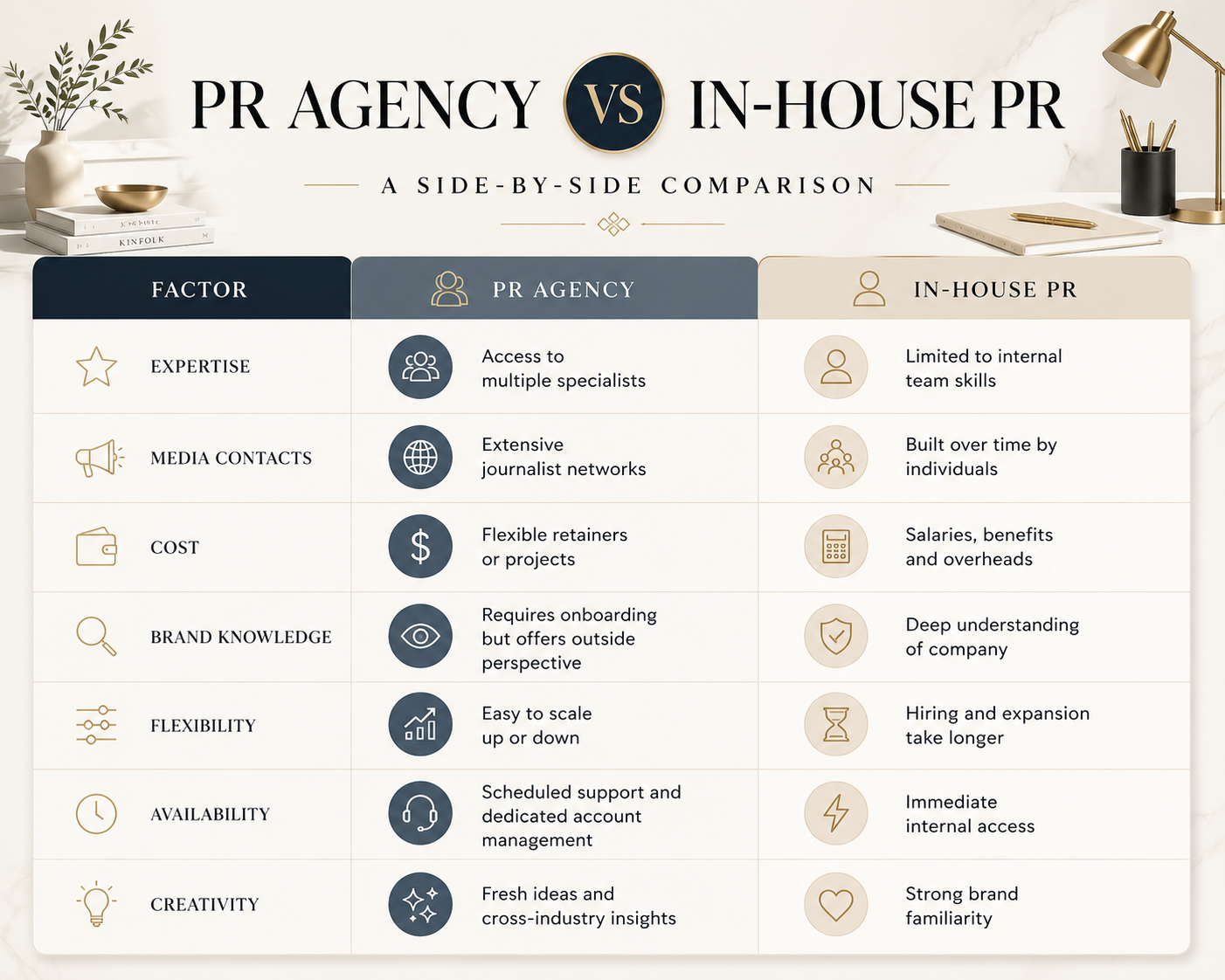
When Should You Hire a PR Agency?
A PR agency may be the best option if your business:
- Is launching a new product or service
- Wants national or international media coverage
- Keen to highlight key team members as experts in their industry
- Needs specialist PR expertise
- Does not have the budget for a full internal team
- Wants fresh creative ideas
- Is entering a new market
- Must have professional crisis communications support
- Wants to combine PR with digital visibility and SEO
PR is relevant to startups, SMEs, challenger brands, and businesses striving to accelerate growth. A PR agency often provides the fastest route to expert support and media opportunities.
When Does In-House PR Make More Sense?
 An internal PR team may be more suitable if your business:
- Has ongoing daily media enquiries
- Requires constant communication support
- Has the budget to build a multi-skilled team
- Needs close collaboration amongst lots of different departments
- Operates in a highly specialised industry calling for extensive internal knowledge
Larger organisations frequently invest in in-house teams to maintain continuous brand management.
The Blended Approach: The Best of Both Worlds
Many successful companies combine an internal marketing or communications team with an external PR agency.
The internal team provides brand insight and strategic direction, while the agency delivers specialist expertise, media relationships, campaign execution, and an external viewpoint.
This model lets businesses stay agile while leveraging professional PR support.
Is a PR Agency Better Than an In-House Team?
 A PR agency is not automatically better than an in-house PR team, and vice versa. The right decision rests on your company’s size, goals, resources, and growth ambitions.
For many businesses, hiring an external PR agency is often the more effective, financially viable and flexible choice when seeking tailored expert advice. stronger media connections, flexible support, and measurable results without the overhead of building a full department.
The most successful PR strategy is one that corresponds with your commercial objectives, strengthens your reputation, and helps your brand stand out in an increasingly competitive marketplace.
Frequently Asked Questions
Is hiring a PR agency worth it?
Yes, hiring a PR agency can be worthwhile for any business seeking professional media relations, strategic communications expertise, industry knowledge, brand awareness, and access to experienced PR specialists without having to build a full internal team.
Is a PR agency cheaper than hiring an in-house PR manager?
In many cases, yes. An external PR agency can provide access to multiple specialists for a monthly retainer, whereas an in-house team involves salaries, recruitment costs, employee benefits, pensions, training, and PR tools. Also, an external agency will have an agreed notice period for both parties, allowing an easy exit, if required.
Do PR agencies have better media contacts?
Established PR agencies will have extensive relationships with journalists and media outlets across distinct sectors. However, successful coverage always depends on the strength, relevance, and newsworthiness of the brand, its products, and its backstory.
Can a business have both an in-house team and a PR agency?
Absolutely. Many brands combine an internal communications team with external PR agencies to benefit from both deep brand knowledge and specialist PR expertise.
How Long Does PR Take to Deliver Results? (And Other Common Questions Answered)